The Cost of Looking Away
An Amsterdam neighborhood is paying the price for our collective indifference
Last week, on one of those rare sunny Amsterdam days that pulls everyone outside, I watched a kid get beaten. Punched, kicked, bullied by a group, right there in the open, surrounded by dozens of people enjoying the weather.
I walked up to the group and confronted them. Asked if everything was alright, what was going on here. Nobody else did.
What followed was predictable in hindsight. The group, around ten teenagers, 15 to 17 years old, turned on me. When they noticed I was recording them, the insults came first. Then they tried to grab my phone. When that failed, they attacked me. Ten against one.
I'm now under medical observation. My right iris still isn't responding properly and the doctors are still assessing whether the damage will be permanent. I was about to start a new job I'm genuinely excited about; now I've had to postpone until I fully recover.
Content warning: photo of injuries (click to reveal)
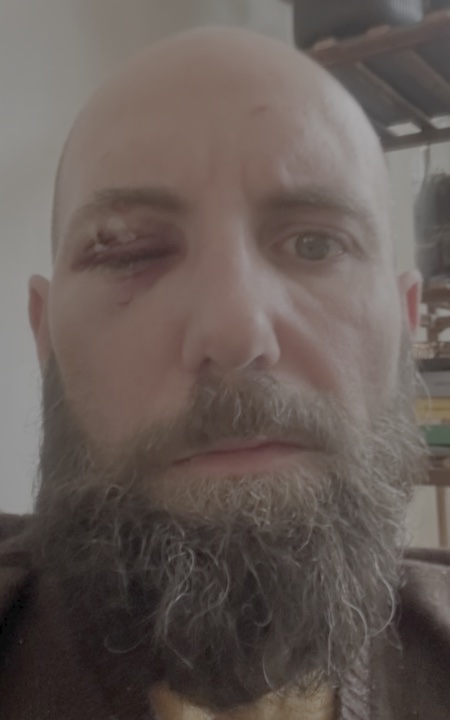
The result of standing up when no one else would.
The silence of the crowd
Here's what haunts me more than the beating itself: I was surrounded by people. Adults. Dozens of them. Sitting on benches, walking by, enjoying the sun. They watched a kid get beaten and did nothing. They watched me get jumped by ten teenagers and did nothing.
When the group attacked me, we ran into three girls who had been sunbathing nearby. They stood up, started screaming, and called the police, which served as a real deterrent. I'm grateful for what they did.
But three young women reacting because violence literally crashed into them, while dozens of grown adults deliberately chose to look the other way? That's the picture. That's the problem.
We like to think of ourselves as a civilized society. We value tolerance, community, looking out for each other, at least in theory. But when a man is being assaulted by a group of teenagers in broad daylight, that civility evaporates into individualism. Someone else will handle it. It's not my problem. I might get hurt.
Three weeks before my assault, a friend of mine was attacked in the same neighborhood. He wasn't intervening in anything. He was just biking home, minding his business. He was simply in the wrong place.
These are not isolated incidents.
The real price tag
You might think that by not getting involved, you stayed safe. And in that moment, you did. But consider this: you could be the lonely one next.
And even if you never are, you're still paying.
My assault was one incident on one afternoon. Look at what it costs all of us: police officers dispatched and filing reports. Municipality resources stretched. A school under scrutiny. I was about to start a new job I'm genuinely excited about; now I've had to postpone until I fully recover. Hospital visits, specialist consultations, follow-up care, all absorbed by a healthcare system we collectively fund. And then the invisible costs: the psychological weight on an entire neighborhood that now feels less safe. Parents who hold their kids a little tighter. People who choose a different route home. A community that trusts itself a little less.
All of that from one sunny afternoon. Multiply it by every incident that goes unreported, every assault that gets shrugged off, every neighbor who decides it's not worth the trouble to speak up. The cost of looking away is never just one person's injuries. It's the slow erosion of the place we all share.
On ethnicity, honestly
I want to address something directly, because avoiding it creates its own problems.
The group that attacked me were teenagers who, like many second-generation immigrants in the Netherlands, navigate between two cultures. I mention this not to assign blame to any community, but because it's part of the context. Ethnicity does not determine behavior. Culture alone doesn't explain this.
But I also won't pretend there isn't a pattern that the neighborhood has noticed. There's a sentiment, and I want to be clear, I have no hard evidence, that some of this youth violence may be connected to a secondary school in the area that has already been the subject of public debate in recent years. I don't believe the people running that school are bad people. But if there's a correlation, it shouldn't be dismissed to avoid uncomfortable conversations.
What I think creates the lethal mix isn't ethnicity or religion. It's the combination: a specific age group prone to pack dynamics, the era we live in where violence gets performed for social media, group psychology that rewards escalation, and yes, some cultural elements around masculinity and street reputation that exist in specific subcultures, not in an entire community.
Polarization feeds on silence. If reasonable people refuse to name what they see, the only voices left are the extremists, and they won't be nuanced about it.
A call to the majority
I didn't do anything extraordinary. I saw a kid getting hurt and I asked what was going on. That should be ordinary. That should be the default.
But it only works if we do it together.
If two or three other adults had stepped in with me, those kids would have backed off. That's how group aggression works; it relies on the passivity of everyone else. The moment bystanders become participants, the dynamic collapses.
So here's what I'm asking:
Don't look away. When you see someone being harassed, bullied, or attacked, do something. You don't have to fight. Call the police. Film it. Shout. Stand next to the victim. Just make it clear that you are there and you will not pretend this isn't happening.
Talk to your neighbors. These problems fester in silence. If your neighborhood is experiencing a pattern of youth violence, discuss it openly. Demand answers from local officials. Support community initiatives that reach these kids before they become a mob.
Understand the real cost. Your safety today is borrowed from the community's silence. Every incident that gets ignored doesn't disappear; it compounds. The resources spent, the trust lost, the fear accumulated; we all carry that weight whether we got punched or not.
This isn't just about one neighborhood. Amsterdam as a whole, especially the center, has been feeling increasingly unsafe. People notice it. They talk about it quietly. But quiet isn't enough anymore.
I'm hopeful. The police investigation is underway and I trust they'll do their work. But policing alone won't fix this. The real change starts with us, the people who live here, who walk these streets, who share these parks on sunny days.
I will not stay silent and let violence spread unchecked. Not in my neighborhood, not in this city.
My right iris still isn't responding properly and the doctors are still assessing whether the damage will be permanent. I'd do it again. But next time, I'd rather not do it alone.
Turning this into something that matters
I've thought a lot about what justice looks like here. Locking up a group of teenagers might feel satisfying for a moment, but it won't change anything. These kids will come out the same, or worse. The cycle continues.
So here's what I'm proposing instead:
Punishment alone doesn't educate. But a story told honestly, by the people who lived it, might. If we can turn one violent afternoon into something that prevents the next one, then maybe getting punched was worth more than I thought.